

For most of my career, “space” was a conversation for governments and a handful of prime contractors — nothing a family business or a growth-stage operator needed to think about. I want to tell you plainly: that’s no longer true, and I find the shift genuinely moving to watch unfold. The economics of getting to orbit have fallen so far, so fast, that space-derived services are quietly becoming infrastructure for ordinary businesses — insurance, agriculture, logistics, telecom — the same way GPS did a generation ago, without most of us ever needing to think about the satellites underneath it.
Why the economics changed
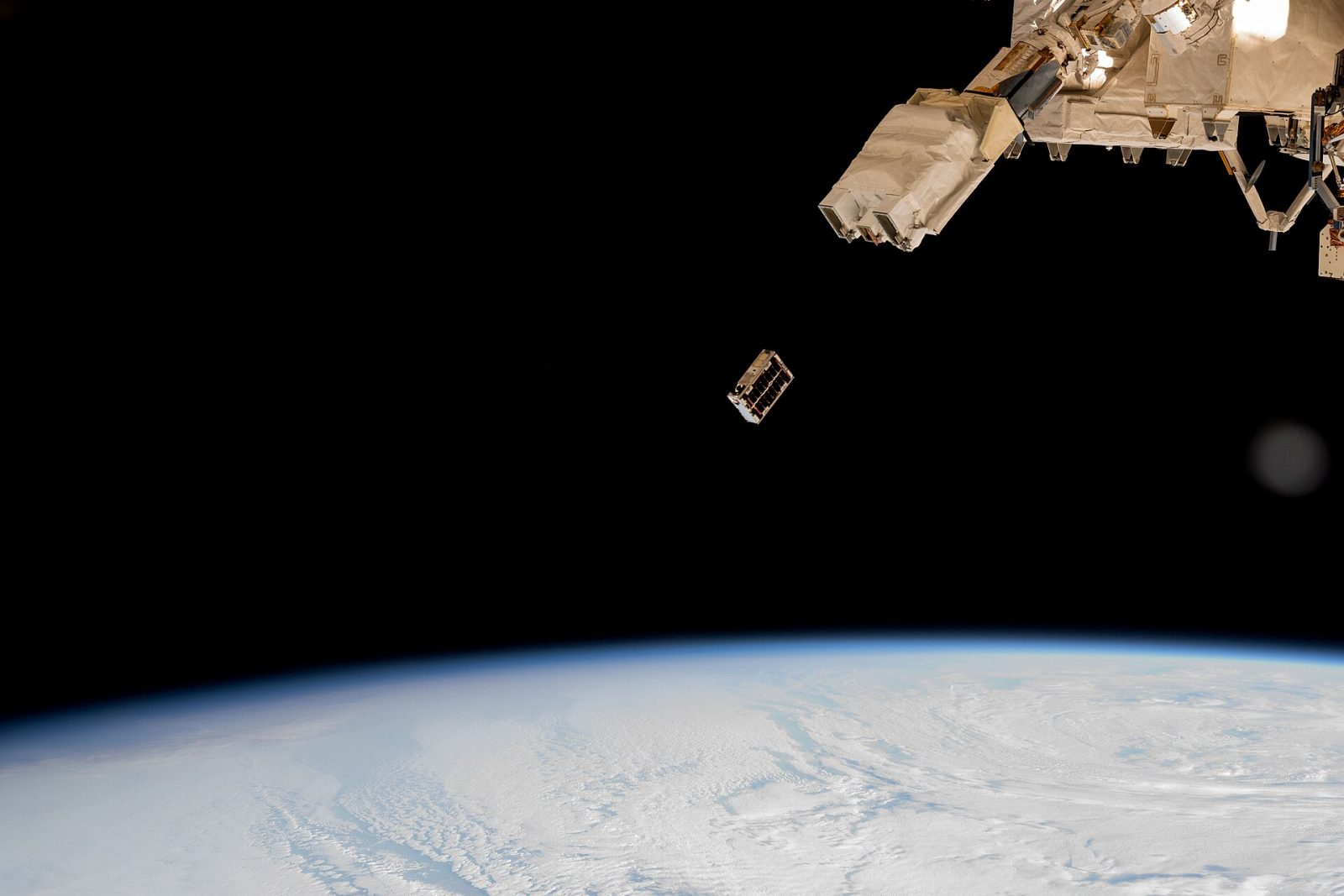
The number that changed everything is launch cost. Putting a kilogram into low Earth orbit cost roughly $65,000 in the Space Shuttle era. Reusable rocket systems have pushed that below $3,000 for some payloads today, with further declines expected as launch frequency increases. That isn’t an incremental improvement — it’s a different industry, full stop. Cheaper launches made small, inexpensive satellites — CubeSats, now routinely deployed in clusters directly from the International Space Station — economically viable at a scale that simply didn’t exist fifteen years ago.
The result is a fast-growing layer of commercial infrastructure sitting quietly in orbit above us: broadband constellations, Earth-observation networks, and increasingly specialized sensing satellites, built and operated by private companies selling data and connectivity as a service, not chasing one-off government contracts.
Where I’ve actually seen this touch businesses that have nothing to do with aerospace
Connectivity in places fiber will never reach
Low-Earth-orbit broadband has made reliable connectivity genuinely viable for maritime shipping, remote mining and agriculture operations, and disaster-response logistics — places where the alternative used to be an expensive satellite phone link, or simply nothing at all. If your business has field operations outside major population centers, this is now a real infrastructure option, not a novelty, and I want you to know that.
Earth observation as a risk and supply chain tool
Insurers are using satellite imagery to assess crop damage and property risk faster, and with more granularity, than a site visit ever could. Commodity traders and logistics firms use the same data to track crop yields, port congestion, and shipping patterns in near-real time. This is a genuinely new category of data for risk and operations teams, not a research curiosity, and I think more operators should know it exists.
Manufacturing and materials, still early
In-space manufacturing — producing certain fiber optics, pharmaceuticals, and materials that benefit from microgravity — is still mostly experimental, but it’s well-funded experimentation, with several companies now flying commercial production payloads rather than pure research missions.
What I’ve learned about the capital-raising side of this
I work with a lot of operators evaluating new-market entry and capital raises, and space-adjacent opportunities land on my desk more often now than they did even two years ago. A few things I’ve learned, that I want to pass on before you evaluate one yourself:
The money is following the applications layer, not the hardware layer. Launch and satellite manufacturing are increasingly consolidated among a small number of well-capitalized players. The more interesting funding activity — and honestly, the more realistic entry point for most investors and operators I know — is in companies building services on top of existing space infrastructure: analytics, specialized sensing, downstream data products. Betting on being the next launch provider is a fundamentally different, far more capital-intensive game than building a business that simply uses satellite data well.
The real diligence item is regulatory, not technological. Orbital slot allocation, spectrum licensing, and increasingly crowded low-Earth-orbit debris and traffic rules are becoming the practical bottleneck for new entrants. I’d rather you understand that before capital changes hands, not after.
“Space” is often a mislabeled infrastructure or data business, and I say this with real affection for how exciting the word “space” sounds in a pitch meeting. The most fundable opportunities I’ve seen aren’t selling rockets — they’re selling the connectivity, imagery, or analytics that happen to be delivered from orbit. Evaluate them the way you’d evaluate any infrastructure or data business: unit economics, customer concentration, defensibility — not the novelty of where the data comes from.
What I’d want you to take from this
You probably don’t need a space strategy. But you may already have a space dependency you haven’t named — the insurer pricing your property risk, the shipping partner routing your freight, or the connectivity vendor serving your remote sites may already be running on satellite infrastructure that didn’t exist a decade ago. For most businesses, simply knowing that is enough. For the smaller number of you evaluating direct investment or market entry here, the same discipline that applies to any new-market decision applies here too: separate the infrastructure story from the applications story, and put your money behind the one with a customer already paying for it.
This same discipline — separating infrastructure hype from a fundable business, and knowing which emerging-technology bets are actually worth real diligence — is the lens my team at Interactive Intel, our dedicated AI and emerging-technology practice, brings to every engagement, space-adjacent or otherwise.
If you’re evaluating a capital raise or new-market entry in an emerging sector — space-adjacent or otherwise — I’d genuinely welcome the chance to think it through with you. Request a consultation, or read more about how I approach capital raising and new market entry.
